Vadzo Imaging Positions Merlin-415CRS: IMX415 Sony Starvis 4K HDR USB 2.0 Camera for Retail Analytics
Built for point-of-sale monitoring, queue management, and store-wide analytics that need dependable video across a full

Press Release Disclaimer: This is a press release distributed through the XPR Media network. It has not been independently verified by our newsroom.


Built for point-of-sale monitoring, queue management, and store-wide analytics that need dependable video across a full day of variable lighting, this camera pairs the Sony IMX415 STARVIS sensor with a high-performance ISP and low-light sensitivity over a standard USB 2.0 connection, giving retail technology providers detailed 4K image quality without a proprietary interface or a networked camera to manage.
IRVINE, CA / ACCESS Newswire / August 26, 2026 / Vadzo Imaging, a provider of embedded vision solutions, today expanded the Merlin-415CRS line with an 8MP HDR USB Camera built around the Sony IMX415 STARVIS sensor for point-of-sale monitoring, customer analytics, and general retail surveillance applications that need both low-light performance and plug-and-play USB connectivity.
Why Retail Analytics Needs an 8MP HDR USB Camera Built for Variable Store Lighting
Retail environments are rarely as evenly lit as they first appear. A storefront entrance can combine bright exterior daylight with dimmer interior aisles within the same field of view, and many stores dim overhead lighting during off-peak hours or evening shifts to reduce energy costs, which leaves a camera that performs well only under bright, even lighting struggling exactly when accurate analytics or security footage matters most. A camera without genuine low-light sensitivity and dynamic range handling forces retail technology providers to accept degraded performance during a meaningful portion of a typical operating day.
An IMX415 Low-Light USB Camera approaches that problem directly at the sensor level, rather than asking downstream analytics software to compensate for a noisy or underexposed frame. Because retail analytics software depends on consistent image quality to make accurate counting, tracking, and identification decisions, a camera that only performs well in bright light introduces a blind spot into exactly the hours when many retail incidents and after-hours activity actually occur.
A second, related challenge is processing that raw sensor data into something genuinely usable rather than merely technically correct. Raw or lightly processed video can still be numerically accurate while looking flat, noisy, or poorly color balanced, which is where ISP Enhanced USB Camera processing becomes as important as the sensor’s raw specifications. A camera that processes exposure, color, and noise reduction onboard delivers footage that is immediately usable for both live monitoring and automated analytics, rather than requiring a retailer’s own systems to perform that correction after the fact.
These two challenges, variable lighting and unprocessed video, tend to compound each other in practice. A camera that solves one but not the other still leaves a retail technology provider with a meaningful gap in coverage, whether that gap shows up as unusable footage during dim hours or as technically correct but poorly processed video that an analytics platform struggles to interpret accurately. Addressing both from the same sensor and processing platform gives a provider one specification to evaluate rather than two separate compromises to manage across a store deployment.
Engineering Explanation: Sensitivity, Processing, and Connectivity Together
Sony developed the IMX415 as part of its STARVIS sensor lineup, which uses Back-Side Illuminated pixel architecture specifically to improve low-light sensitivity beyond what a conventional front-illuminated sensor of similar size can achieve. As a Sony IMX415 Camera, the sensor pairs that STARVIS low-light foundation with 8-megapixel resolution, giving retail integrators a single sensor that covers both detailed daytime monitoring and usable after-hours or low-light footage.
That sensor performance is only half of the engineering story. As a 4K High-Performance ISP USB Camera, the Merlin-415CRS pairs the IMX415 with a dedicated image signal processor handling exposure, color correction, and noise reduction directly on the module. A high-performance USB Camera Module configuration like this one means the video a retail analytics system receives has already been corrected, rather than requiring a store’s own software to guess at corrections from raw or lightly processed sensor data.
HDR processing works alongside that ISP correction to handle the dynamic range challenge retail environments present. As an IMX415 8MP HDR Camera, the sensor extends dynamic range within a single frame, holding detail in both a bright storefront window and a dimmer interior aisle at the same time. An IMX415 HDR Sensor configuration like this one avoids the ghosting that a moving customer or shopping cart would introduce into a multi-frame blended HDR image, which matters directly for a retail floor that is rarely still.
Delivering all of that processed, HDR video over a standard USB 2.0 connection is the final piece of the design. As a 4K USB 2.0 Camera, the Merlin-415CRS enumerates as a standard UVC device without a proprietary driver, and functioning as a STARVIS Low Light USB Module, it gives retail technology providers a familiar, widely supported connectivity option rather than a specialized interface that would complicate integration with existing point-of-sale or recording hardware.
Product Overview
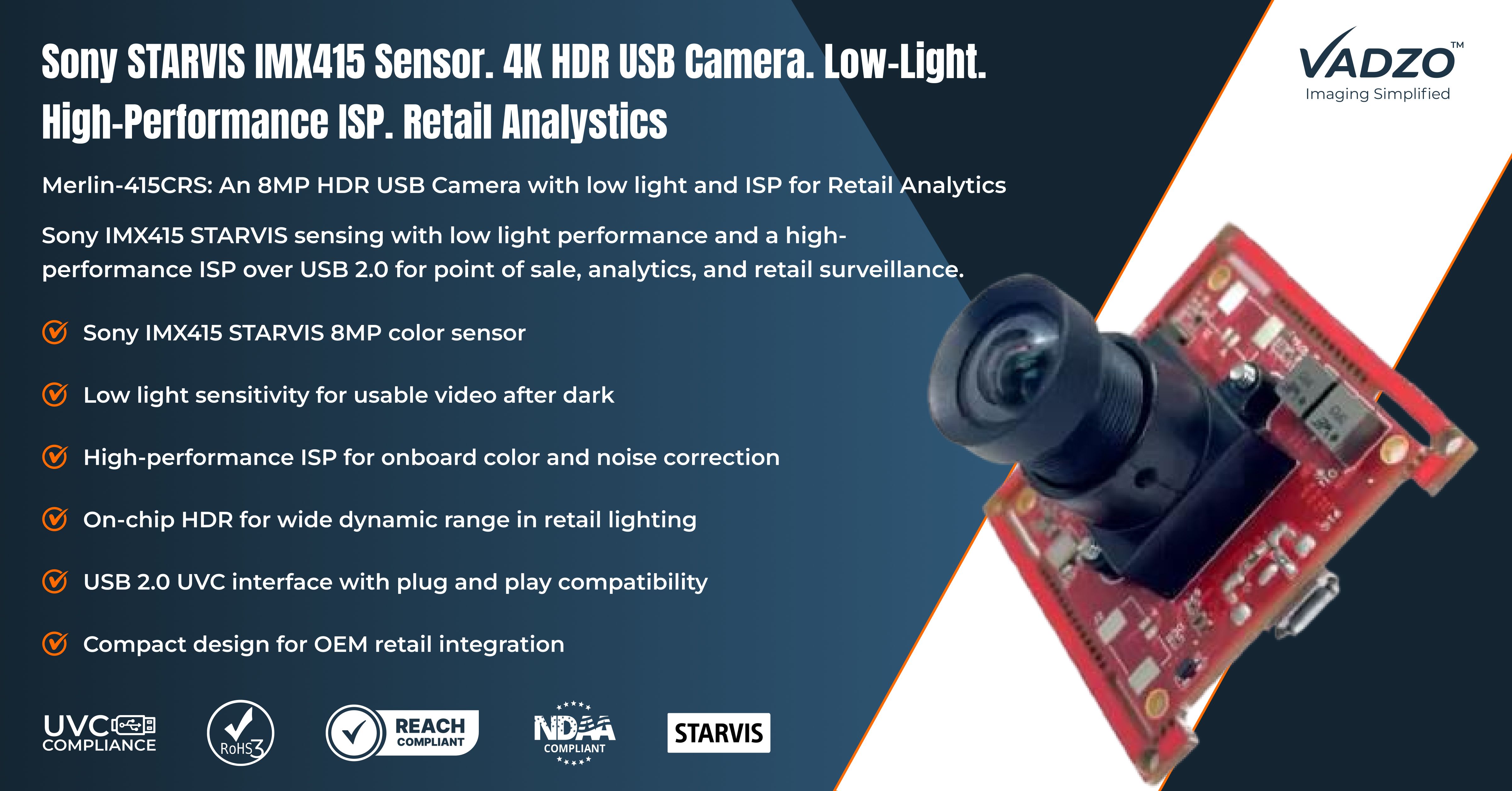
The Merlin-415CRS pairs the IMX415 USB Camera sensor with a high-performance ISP, low-light optimization, and USB 2.0 UVC connectivity in a compact design suited to point-of-sale, shelf, and general retail monitoring integration. As an 8MP HDR USB Camera, it outputs full 8-megapixel resolution with HDR processing active by default, giving retail technology providers a single camera platform that covers checkout monitoring, customer analytics, and general-purpose retail surveillance from one module.
At the core of the module sits the 4K Low Light USB Camera sensor, chosen specifically for the combination of low light sensitivity and dynamic range handling that retail deployment across a full operating day requires. Because the camera pairs 8MP Low Light USB Camera sensitivity with 4K ISP Camera Module processing, the Merlin-415CRS reaches usable image quality from bright midday store hours through dim evening shifts, all delivered over a standard USB 2.0 connection that most existing retail hardware already supports.
Product Specifications
Key specs: 8MP (3864 × 2192) | Sony IMX415 STARVIS, 1/2.8 inch | 1.45 µm pixel | Rolling Shutter with HDR | USB 2.0 UVC | High-Performance ISP | Low Light Optimized | S-Mount (M12)
Key Capabilities
Sony IMX415 STARVIS Sensor for Detailed 8MP / 4K Capture: The Merlin-415CRS is built around the Sony IMX415 sensor, an 8 megapixel STARVIS device that delivers both full-resolution still capture and 4K video output from the same hardware. This gives the module genuine 8MP ISP USB Camera performance suited to retail applications that need high-resolution detail for identification tasks alongside general-purpose monitoring video, without switching camera hardware between those two needs. As a 4K USB Camera Module, it also fits directly into Vadzo Imaging’s broader 4K camera portfolio, giving integrators a consistent point of comparison against other 4K capable modules regardless of interface.
Low Light Sensitivity for Usable Video After Dark: STARVIS Back-Side Illuminated pixel architecture routes a larger share of incoming light to the photodiode than a conventional sensor design of similar size, which is what gives the Merlin-415CRS usable low-light performance during dimmed evening hours or after closing. As a Retail Vision USB Camera, it holds that performance across a full operating day rather than only during peak lit hours, which matters directly for stores that reduce lighting during slower periods to manage energy costs.
High Performance ISP for Clean, Accurate Color and Detail: Raw sensor data is rarely usable without correction, and asking a retailer’s own analytics or recording software to perform that correction on already compressed video produces worse results than correcting it on the camera itself. As a Low Light ISP Camera, the Merlin-415CRS handles that processing onboard, delivering already corrected, analytics-ready video rather than raw data that still needs work after it reaches a store’s recording system.
HDR for Wide Dynamic Range in Retail Lighting: A single retail frame routinely contains both a bright storefront window and a shadowed aisle, which is a dynamic range problem a standard exposure setting cannot solve regardless of how well it is tuned. On-chip HDR processing holds detail across that full range in a single exposure, avoiding the ghosting that a moving customer or shopping cart would introduce into a multi-frame blended HDR image, which matters for a retail floor that is rarely still long enough for a multi-frame technique to work cleanly. This single exposure approach to dynamic range also keeps latency low enough for live monitoring applications, where a delay introduced by combining multiple frames after capture would be a genuine drawback rather than a minor technical detail.
USB 2.0 UVC Plug and Play Compatibility: As a USB 2.0 UVC Camera Module, the Merlin-415CRS enumerates automatically on Windows, Linux, macOS, and Android without a proprietary driver install, which matters directly for retail technology providers integrating a camera into existing point-of-sale terminals or recording hardware that already expects a standard UVC device. This makes it a genuine HDR USB Camera Module option for integrators who need HDR image quality without a networked interface or a custom capture card.
Compact OEM-Ready Design for Retail Integration: The module’s compact footprint gives OEM customers flexibility to integrate the Merlin-415CRS into a point-of-sale terminal, a shelf edge fixture, or a ceiling-mounted enclosure without a major mechanical redesign. Vadzo Imaging supports full customization on this platform as an OEM ISP USB Camera Module, including connector changes, housing design, and firmware adjustments for retail technology providers headed into volume production.
“Retail technology providers keep telling us the same thing: a camera that only performs well during bright daytime hours is not actually solving their problem, since a meaningful share of retail activity, and a meaningful share of incidents worth reviewing, happen during dimmer hours. The IMX415’s STARVIS low light sensitivity combined with a high-performance ISP gives the Merlin-415CRS genuine image quality across a full operating day, delivered over the same simple USB connection retailers already know how to integrate. We built this camera for stores that do not close their analytics needs when the lights get dimmer.” – Alwin Vincent, Product Manager at Vadzo Imaging.
Application-Specific Sections
Point of Sale and Checkout Monitoring: Checkout lanes need vision that reliably captures transactions and identifies items across lighting that varies between overhead store lighting and a point of sale terminal’s own screen glow. As a Point of Sale Camera Module, the Merlin-415CRS handles that mixed lighting, and functioning as a Retail Security USB Camera, it extends the same coverage to loss prevention monitoring at the same checkout position.
Customer Analytics and Footfall Counting: Customer traffic patterns, dwell time, and footfall counts all depend on consistent image quality across a store’s entrances and aisles throughout a full operating day. As a Customer Analytics USB Camera, the Merlin-415CRS supplies that consistency, and a Footfall Counting Camera configuration of the same module gives retail analytics providers dependable input regardless of what time of day traffic is being measured.
Queue Management and Store Operations: Queue length and wait time monitoring depend on a camera that resolves individual customers clearly enough to count accurately, even near an entrance where lighting can shift quickly as doors open and close. A Queue Management Camera built on this platform holds that accuracy across those lighting transitions, supporting both staffing decisions and customer experience improvements based on real queue data rather than estimates. Store operations teams can use that same data to identify predictable peak periods over time, adjusting staffing schedules proactively rather than reacting to long lines only after customers have already noticed them.
Retail Security and Loss Prevention: Loss prevention teams need camera coverage that holds up under scrutiny across an entire operating day, including the dimmer hours when a meaningful share of shrink-related incidents tend to occur. As a Retail Surveillance USB Camera, the Merlin-415CRS delivers that coverage, and functioning as a Smart Store Camera Module, it extends the same capability to general store operations monitoring beyond dedicated security tasks.
OEM Integration for Retail Technology Providers: Retail technology providers building their own point of sale, analytics, or security hardware need a camera vendor who understands the lighting and connectivity requirements those platforms demand. The Merlin-415CRS ships from a USB Retail Camera Supplier with those requirements built in, and Vadzo Imaging supports OEM customization for cable length, connector type, and firmware for providers standardizing on one camera across multiple retail hardware lines. As a Retail Store Monitoring Camera, it fits directly into a provider’s existing product architecture without requiring a redesign around a new camera’s specific requirements.
Frequently Asked Questions
Q: Why would a retail analytics camera need HDR and low light performance when most stores are already well lit?
A: Even a well-lit store rarely has even lighting throughout, since entrances combine bright exterior daylight with dimmer interior aisles, and many stores deliberately dim overhead lighting during off-peak hours or after closing to reduce energy costs. A camera that only performs well under bright, even lighting produces degraded footage exactly during the transition zones and lower light hours when accurate counting, tracking, and security review often matter most. Vadzo Imaging builds HDR and low-light sensitivity into its retail camera products specifically because a store’s actual lighting is rarely as uniform as a walkthrough during business hours might suggest, and analytics accuracy should not depend on which hour of the day an event happens to occur.
Q: Why does a retail camera need a dedicated ISP rather than relying on analytics software to correct the image afterward?
A: Analytics software makes counting, tracking, and identification decisions based on whatever image quality it receives, and a raw or lightly processed frame that looks flat, noisy, or poorly color balanced gives that software a weaker starting point regardless of how sophisticated the analytics algorithm itself is. Processing exposure, color, and noise reduction directly on the camera means the video reaching a retailer’s analytics platform has already been corrected, rather than asking downstream software to compensate for problems that were easier to solve at the sensor. Vadzo Imaging builds a dedicated image signal processor into its retail camera products for exactly this reason, since correcting an image after the fact is consistently less reliable than correcting it at the source.
Q: Can a single USB camera really support both point of sale monitoring and general store surveillance from one installation?
A: Yes, provided the camera is positioned and specified with both tasks in mind from the start rather than being optimized narrowly for one. A camera with enough resolution to read transaction details at a checkout counter, combined with wide dynamic range and low light sensitivity, generally has enough capability left over to also serve as general area surveillance covering the same or an adjacent space. Vadzo Imaging designs its retail camera products around that dual-purpose use case specifically, since most retail technology providers would rather standardize on one capable camera platform than deploy separate hardware for point-of-sale monitoring and general surveillance at the same location. Consolidating both roles into one camera also reduces the total number of devices a store’s IT or facilities team needs to install, power, and maintain, which adds up meaningfully across a location with multiple checkout lanes.
Q: Can Vadzo Imaging customize a retail USB camera module for a specific point of sale or analytics platform?
A: Yes. Vadzo Imaging supports full OEM customization across its retail camera portfolio, including lens and mount configuration suited to a specific terminal or fixture, cable length and connector changes, and firmware adjustments tuned for a particular ISP or HDR profile. Evaluation units ship with no minimum order requirement, and the same engineering team that built the standard product works directly with retail technology providers to adapt the module for a specific point of sale, analytics, or security platform headed into volume production.
Q: How does Vadzo Imaging help retail technology providers keep image quality consistent across a large number of store locations over time?
A: Consistency across a large deployment depends less on any single camera’s specifications and more on whether the same hardware and firmware platform remains available and stable over the multi-year timeline a retail rollout typically spans. Vadzo Imaging supports that consistency by maintaining a stable core platform across a long product lifecycle, backed by direct engineering support so a retail technology provider is not left managing several different camera generations across different phases of the same rollout. That approach lets a provider scale from an initial pilot location to a full chain-wide deployment without the image quality or integration experience changing partway through. A provider evaluating a new camera generation mid-rollout faces real integration risk, since even small firmware or behavioral differences can complicate support across a mixed fleet of older and newer units in the field.
Availability
The Merlin-415CRS 8MP HDR USB Camera is available now for evaluation and OEM integration. Evaluation kits include the camera module, a factory-calibrated S-Mount lens, a USB cable, and integration documentation covering ISP configuration, low light tuning, and HDR setup, with no minimum order requirement. Contact Vadzo Imaging at support@vadzoimaging.com to request an evaluation unit or discuss volume production and OEM customization. Evaluation feedback is also welcome directly through the same contact channel, since real store deployment conditions often surface details a bench test alone would not reveal.
About Vadzo Imaging
Vadzo Imaging develops embedded and machine vision camera products for OEMs, system integrators, and retail technology providers building production-ready vision systems across retail analytics, security, robotics, and edge AI. The company’s portfolio spans MIPI CSI-2, USB, GigE, Wi-Fi, FPD-Link III, and SerDes interface camera products, supporting deployment architectures from compact onboard modules to distributed networked and coax-connected installations. Vadzo provides end-to-end imaging support, including sensor integration, ISP tuning, firmware development, and SDK frameworks to accelerate system deployment, and the company’s engineering team works directly with customers throughout evaluation, pilot deployment, and volume production rather than handing off support after the initial sale. Visit Vadzo Imaging to explore the full embedded vision camera portfolio.
Media Contact
Alwin Vincent
Vadzo Imaging
Email: alwin@vadzoimaging.com
LinkedIn: Vadzo Imaging
YouTube: Vadzo Imaging
X: Vadzo Imaging
SOURCE: Vadzo Imaging
View the original press release on ACCESS Newswire
Media gallery