Supercritical Insoles: Technology, Benefits, and Applications
DONGGUAN, GUANGDONG, CHINA, August 24, 2026 /EINPresswire.com/ -- Polymer science continues to transform the

Press Release Disclaimer: This is a press release distributed through the XPR Media network. It has not been independently verified by our newsroom.
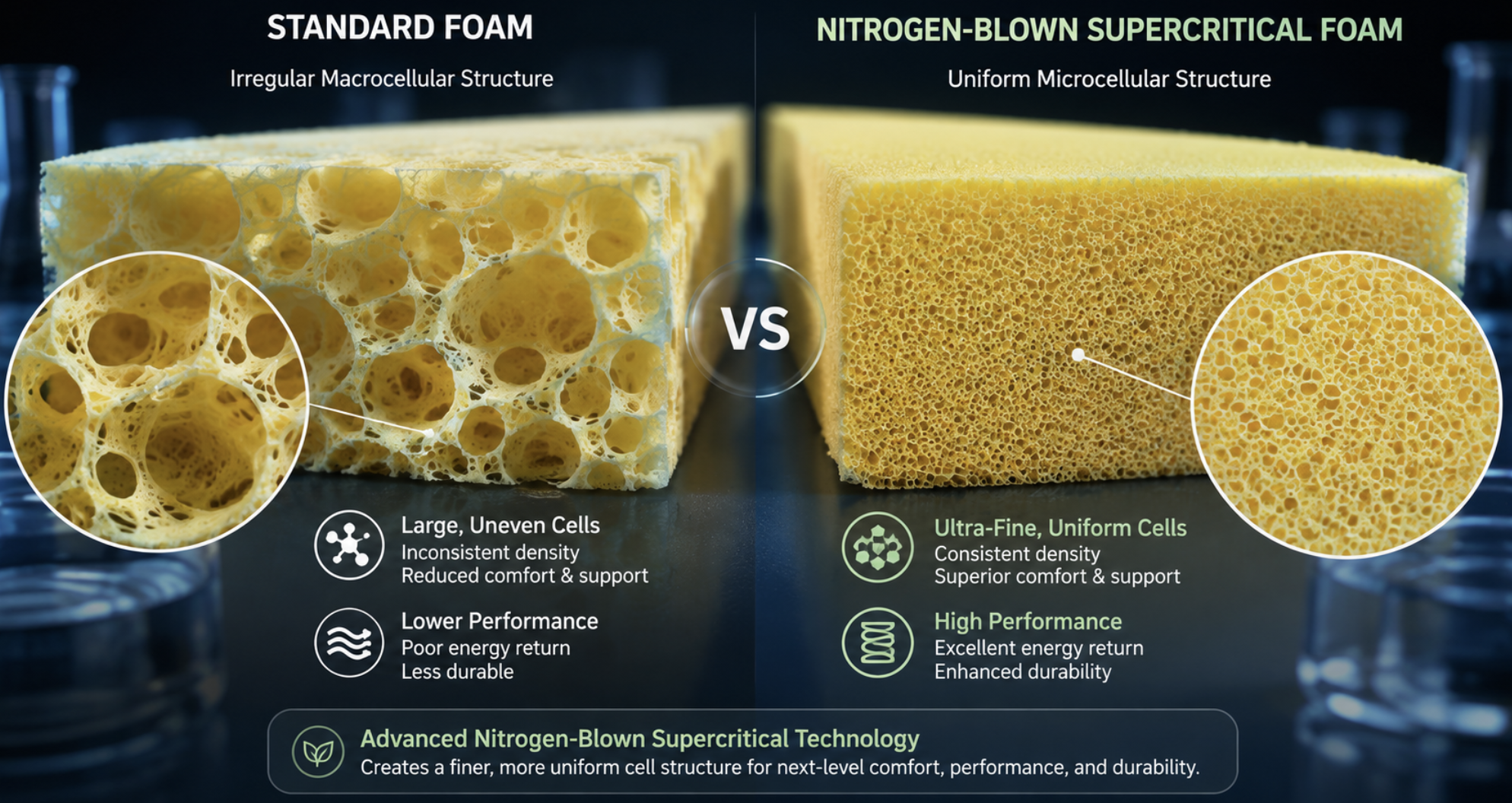

DONGGUAN, GUANGDONG, CHINA, August 24, 2026 /EINPresswire.com/ — Polymer science continues to transform the performance footwear sector through advanced physical foaming technologies. For decades, component manufacturers faced a fundamental trade-off between lightweight cushioning and long-term elastic resilience. Traditional chemical blowing agents created uneven macrocellular structures that degraded quickly under dynamic impact forces. Today, physical gas-injection methods eliminate these performance limitations. Incorporating high-performance Supercritical Insoles into sports footwear allows brand developers to reduce overall shoe weight while dramatically increasing strain energy recovery. By eliminating hazardous chemical expansion agents, physical foaming meets stringent environmental regulations while delivering unmatched mechanical endurance. By manipulating gas phase transitions during primary processing, polymer engineers create uniform microcellular matrices that maintain structural integrity across demanding athletic applications.
The technical foundation of this innovation relies on supercritical fluid thermodynamics. Processing equipment introduces inert gases, such as nitrogen or carbon dioxide, into molten polymer matrices under precise temperature and high-pressure conditions. Under supercritical conditions, where the gas exhibits properties of both liquids and gases, it acts as an effective plasticizing solvent. The gas dissolves uniformly throughout the molten polymer compound. When technicians rapidly drop system pressure, thermodynamic instability triggers immediate supersaturation. Consequently, billions of microscopic gas nucleations form simultaneously across the polymer matrix. This controlled physical expansion produces closed-cell bubbles measuring merely a few micrometers in diameter. In contrast to traditional chemical foams, these uniform microcellular structures feature ultra-thin cell walls that deliver exceptional structural memory, high tear strength, and superior resistance to compression set.
Material Synergy: Multi-Polymer Platforms in Supercritical Processing
Supercritical physical foaming adapts seamlessly across multiple polymer formulations, enabling specialized mechanical properties for varied athletic needs. In traditional ethylene-vinyl acetate (EVA) compounds, physical gas injection refines structural elasticity while reducing material density by up to forty percent. Advanced high-elastic variations, such as Crit-X formulations, leverage this microcellular density reduction to maximize rebound velocity without adding dead weight. These versatile EVA-based solutions serve as durable, high-performing footbeds across multi-sport training footwear, outdoor hiking boots, and daily running shoes.
Beyond standard polyolefins, engineering polymers like Polyether Block Amide (PEBA) achieve unprecedented mechanical performance under supercritical expansion. Supercritical PEBA exhibits energy return metrics exceeding eighty percent, alongside exceptional flexural endurance in extreme sub-zero temperatures. Marrying PEBA elasticity with microcellular physical foaming yields hyper-lightweight racing insoles that reduce kinetic energy loss during marathon distance running. Similarly, specialized material architectures like SCF Activ10 deliver tailored impact damping and dynamic responsiveness for high-frequency court sports. This multi-material versatility allows footwear engineers to fine-tune energy restoration and stiffness profiles for specific athletic disciplines.
Key Performance Benefits in High-Intensity Athletic Applications
The biomechanical advantages of supercritical microcellular insoles extend directly to athletic output and foot health. During high-intensity running or jumping, footbeds absorb intense vertical impact forces. Conventional chemical foams dissipate a significant portion of this impact energy as waste heat. Microcellular supercritical structures, however, store impact energy through symmetrical elastic cell wall deformation. As the athlete transitions from mid-stance to toe-off, the compressed micro-cells spring back immediately. This rapid structural recovery converts stored kinetic forces into forward propulsive assistance, reducing muscular strain across lower leg joints and stabilizing body alignment during endurance sports.
Furthermore, physical supercritical foaming delivers outstanding long-term durability and environmental compliance. Traditional chemical blowing agents leave behind toxic organic residues, hazardous decomposition products, and volatile organic compounds. In contrast, physical nitrogen or carbon dioxide foaming utilizes clean, naturally occurring gases that leave zero chemical residue within the finished polymer. Additionally, the uniform microcellular walls resist cell collapse under repetitive dynamic loads. Consequently, supercritical insoles preserve their original thickness, cushioning softness, and rebound percentage over hundreds of miles of rigorous athletic wear.
How Foamwell Drives Next-Generation Supercritical Insole Manufacturing
Commercializing these advanced thermodynamic principles requires specialized manufacturing infrastructure and deep chemical engineering expertise. Foamwell operates at the forefront of technical foam innovation, developing clean physical foaming processes for global footwear brands. The company’s engineering team has perfected gas saturation levels, temperature profiles, and rapid pressure drop cycles across EVA, PEBA, Crit-X, and specialized SCF Activ10 polymer platforms. This precise process control eliminates internal structural defects, ensuring consistent batch-to-batch density and uniform rebound performance across automated production runs.
Moreover, the manufacturer combines material innovation with comprehensive OEM and ODM custom solutions. Sourcing managers and footwear product teams collaborate directly with technical specialists to engineer custom mold geometries, Shore C hardness levels, and targeted biomechanical support zones. Whether designing contoured deep U-shaped heel cups for rearfoot stability or thin, ultra-lightweight inserts for elite marathon racing flats, the supplier executes rapid 3D prototyping and precise chemical adjustments. By pairing sustainable, zero-VOC physical foaming technology with ISO-certified quality management systems and large-scale injection machinery, the company provides international footwear brands with high-performance, environmentally responsible insole solutions.
Engineering Procurement Framework: Evaluating Supercritical Insoles for Product Lines
Integrating supercritical components into commercial footwear lines demands a rigorous, data-driven procurement audit. Footwear development teams should execute a systematic four-step evaluation framework during supplier selection. First, procurement teams must verify cell wall uniformity and density gradients through microscopic cross-sectional inspection. Consistent pore distribution guarantees predictable mechanical behavior under varying load conditions and prevents unexpected field failures. Second, mechanical engineers should quantify strain energy restoration and hysteresis loops through dynamic mechanical analysis. High-performing supercritical samples should demonstrate rapid elastic recovery and minimal energy loss under high strain rates.
Third, sourcing directors must conduct environmental thermal testing and mileage fatigue audits. Testing sample footbeds under extreme heat, freezing conditions, and repeated dynamic compression ensures the material maintains its cushioning volume throughout the footwear life cycle. Fourth, brand managers should evaluate the supplier’s rapid 3D prototyping capabilities and multi-material co-development agility. Partnering with a component manufacturer that offers flexible chemical tuning and fast sample turnaround significantly reduces overall product development timelines.
The Future of Athletic Footbeds: Scaling Advanced Physical Foaming
The transition from legacy chemical foams to engineered supercritical microcellular matrices marks a pivotal milestone in footwear component development. Combining ultra-lightweight construction, exceptional energy return, and clean physical processing allows athletic brands to meet demanding performance criteria and environmental standards simultaneously. As polymer physics continues to evolve, supercritical physical foaming will remain a cornerstone technology for high-performance sports footwear.
Global footwear developers and product sourcing directors seeking to integrate advanced supercritical EVA, PEBA, Crit-X, and SCF Activ10 insole solutions can explore technical formulations and custom OEM/ODM manufacturing capabilities at https://www.foam-well.com/.
Foamwell Limited
Foamwell Limited
+ +86 13549380132
email us here
Legal Disclaimer:
EIN Presswire provides this news content “as is” without warranty of any kind. We do not accept any responsibility or liability
for the accuracy, content, images, videos, licenses, completeness, legality, or reliability of the information contained in this
article. If you have any complaints or copyright issues related to this article, kindly contact the author above.

Media gallery