
Architectural Specifications for Custom Aluminum Windows: Aligning DERCHI Solutions with European Residential Trends
FOSHAN, CHINA, August 24, 2026 /EINPresswire.com/ -- Specifying windows for a high-end residential project in Europe

Press Release Disclaimer: This is a press release distributed through the XPR Media network. It has not been independently verified by our newsroom.
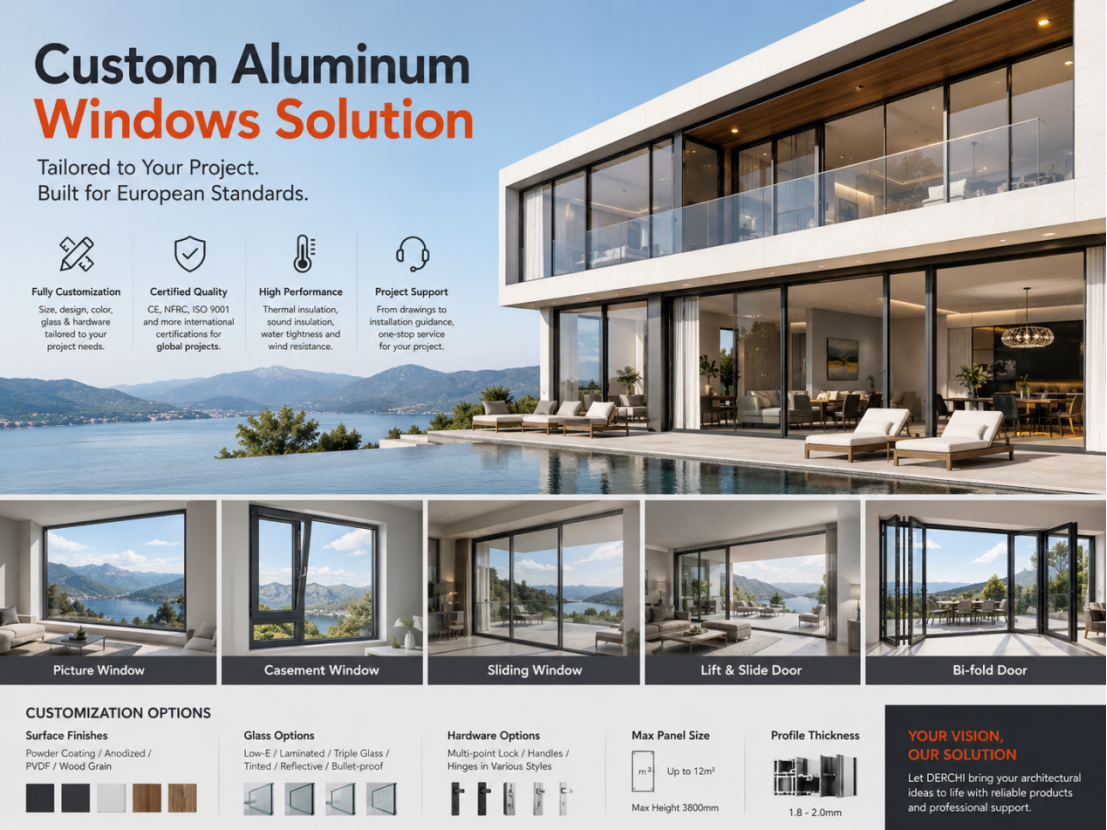

FOSHAN, CHINA, August 24, 2026 /EINPresswire.com/ — Specifying windows for a high-end residential project in Europe has never been a straightforward catalogue exercise. Every project presents a different combination of planning constraints, energy targets, façade geometry, and client expectations — and the gap between “window as product” and a genuine custom aluminum windows solution capable of meeting all of them simultaneously is where most procurement decisions get complicated. European architects and developers are increasingly looking beyond branded system profiles to ask a more practical question: which supplier can actually customise to the brief, certify to the standard, and deliver at the project scale required? The answer, more often than not, hinges on how a manufacturer approaches the specification stage — not just what they list in a product catalogue, but how flexibly they can respond to the specific dimensional, performance, and finish requirements a project brief actually contains.
What European Residential Architecture Is Demanding Right Now
Several converging trends are reshaping how high-end residential windows get specified across Europe. First, the push toward larger glass openings — floor-to-ceiling glazing, corner windows, panoramic sliding walls — requires frame systems engineered for larger spans without compromising weather performance. Second, tightening energy regulations (UK Part L, Germany’s GEG, France’s RE2020) mean that glazing choices now feed directly into building compliance calculations, making U-values and glass configuration a design decision, not an afterthought.
Third, the shift away from standard-catalogue windows toward project-specific bespoke aluminum window systems is accelerating. Architects working on luxury villas, refurbishments in heritage zones, or multi-unit premium developments increasingly need custom dimensions, non-standard opening configurations, and surface finishes that match specific planning or design briefs — not what happened to be available in a standard brochure. The suppliers that thrive in this environment are the ones who can accommodate all three demands simultaneously.
The Specification Checklist: What to Align Before Placing an Order
For architects and project managers, the specification of custom residential aluminium windows covers seven distinct layers, each with downstream consequences for performance and compliance:
Profile thickness and alloy — Frame wall thickness affects structural rigidity and long-term dimensional stability. For large-format panels, a heavier profile is not optional; it is a structural requirement.
Thermal break configuration — The insulating barrier between the inner and outer aluminum profiles is the primary mechanism for reducing conductive heat loss through the frame. Glazing choice matters equally: argon-filled double glazing is the baseline; triple glazing or Low-E coatings push performance further for projects targeting stricter energy ratings.
Glass specification — Beyond standard double-tempered units, the configuration of glass (Low-E, laminated, tinted, reflective, or triple-pane) determines thermal transmittance, solar heat gain, acoustic performance, and UV control. Each variable shifts the performance profile in a different direction.
Surface finish and colour — Powder coating (typically RAL palette), anodising, PVDF coating, and wood-grain finishes each have different durability profiles across climate types. A PVDF-finished frame on a south-facing Mediterranean façade behaves very differently from one finished in standard powder coat in a northern coastal environment.
Opening type — Fixed picture windows, casement, tilt-and-turn, sliding, lift-and-slide, and bi-fold configurations each have different sealing efficiencies, structural requirements, and use-case fits. The specification must align opening type with room function, ventilation strategy, and façade orientation.
Panel dimensions — Maximum panel size is a hard constraint that determines whether mid-frame mullions are required. For architects designing open, uninterrupted façades, a supplier’s maximum span capacity is a critical spec point.
Certification documentation — For European projects, CE marking is the minimum legal requirement. Projects with sustainability goals may also need Energy Star or ISO 9001 documentation for planning or green building submissions.
How DERCHI‘s Range Maps to European Project Scenarios
DERCHI (Guangdong Dejiyoupin Doors and Windows Co., Ltd.) covers the full aluminum door and window spectrum: fixed picture windows, casement windows, tilt-and-turn windows, sliding windows, lift-and-slide doors, bi-fold doors, swing doors, and entrance doors. Critically, these product lines share surface finish options, hardware families, and glazing configurations — which means a multi-opening villa façade can be specified as a coherent system rather than assembled from mismatched suppliers.
The Fix Picture Panoramic Window handles fixed glazing panels up to 12 m² per unit, with a maximum height of 3,800mm — accommodating the full-height floor-to-ceiling glazing that defines contemporary luxury residential design. For operable openings on the same façade, the casement and sliding window ranges operate within the same customisation framework: profile thickness of 1.8–2.0mm, surface finishes in powder coating, anodising, PVDF, or wood-grain, and a glass configuration that includes Low-E, laminated, triple glazing, tinted, and reflective glass options as project-specific selections.
Hardware across the range is sourced from KERSSEMBERG, available in black or silver, with DERCHI’s proprietary Four-Side Six-Point Lock system — protected by a national invention patent — providing multi-point structural engagement across operable units.
Matching the Specification to European Climate Zones
Europe is not a single climate, and specifying custom aluminum windows as if it were leads to predictable underperformance. Three broad scenarios illustrate how the specification shifts:
Northern and central Europe (Germany, Scandinavia, UK, Benelux): Projects in these regions are typically targeting low U-values to meet heating-season energy standards. Triple glazing with argon fill and Low-E coatings pushes glass performance toward the levels required for near-passive-house specifications. Warm-edge spacers between panes reduce condensation at the glass edge, a persistent issue in colder climates. DERCHI’s argon-filled base configuration with PVDF aluminium spacer bars provides the foundation; triple-pane and Low-E upgrades address the more demanding energy targets.
Mediterranean Europe (Spain, southern France, Italy, Greece): The performance priority shifts. Solar heat gain control becomes the primary glazing variable — solar control glass and reflective coatings reduce cooling loads rather than heating losses. PVDF coating on frames offers superior UV resistance and colour stability for south-facing façades exposed to high levels of solar radiation year-round.
Atlantic façades and coastal locations (western France, Portugal, Ireland, northern Spain): Wind-driven rain resistance and structural rigidity under dynamic wind loads are the governing performance criteria. DERCHI’s triple-seal EPDM perimeter design and titanium-magnesium aluminium alloy frame construction address both — continuous perimeter sealing eliminates pressure-driven water infiltration, while the alloy’s strength-to-weight properties maintain structural performance under sustained wind loading. The wood-grain anodised finish also holds up well in salt-air coastal environments where standard powder coat finishes degrade faster.
From Drawing to Site: How the Specification Becomes a Delivered Project
The gap between a completed specification and a window arriving on site correctly is where many procurement relationships break down. DERCHI’s project workflow follows eight structured stages: initial drawings, R&D review, project quotation, specification finalisation, on-site measurement confirmation, production, quality verification, and installation guidance — with each stage formally documented before the next begins.
Backed by a 180,000 m² manufacturing base with annual production exceeding 1,000,000 m², the company holds over 100 independently developed national patents and runs production through a 360-degree intelligent quality control system. For European developers and architects, the certification stack — CE, ISO 9001, NFRC, Energy Star, and Hurricane Certification among others — provides the documentation trail required for planning submissions, building control sign-off, and green building accreditation.
Over 18,000 completed projects globally, across villas, hotels, residential developments, and commercial buildings, sit behind that process. The service package includes a 10-year warranty and ongoing post-installation support — which for clients means a formal backstop, not a hope.
Recognised by Xinhua News Agency as a “China Famous Brand” and supported by a network of 300+ overseas franchise partners, DERCHI operates at the scale and certification depth that European project procurement actually requires.
Working on a European residential or villa project? DERCHI’s technical team supports architects and developers from initial specification through to delivery — covering glazing configuration, CE documentation, custom dimensions, and full-façade product matching. Explore the full custom aluminium window range and submit a project enquiry at www.dejiypwindow.com
DERCHI
DERCHI
86-15878811461
email us here
Legal Disclaimer:
EIN Presswire provides this news content “as is” without warranty of any kind. We do not accept any responsibility or liability
for the accuracy, content, images, videos, licenses, completeness, legality, or reliability of the information contained in this
article. If you have any complaints or copyright issues related to this article, kindly contact the author above.

Media gallery

