Vadzo Imaging Positions the Bolt-900MGS IMX900 Sony Pregius S based Monochrome MIPI Camera for Embedded Robotics Vision
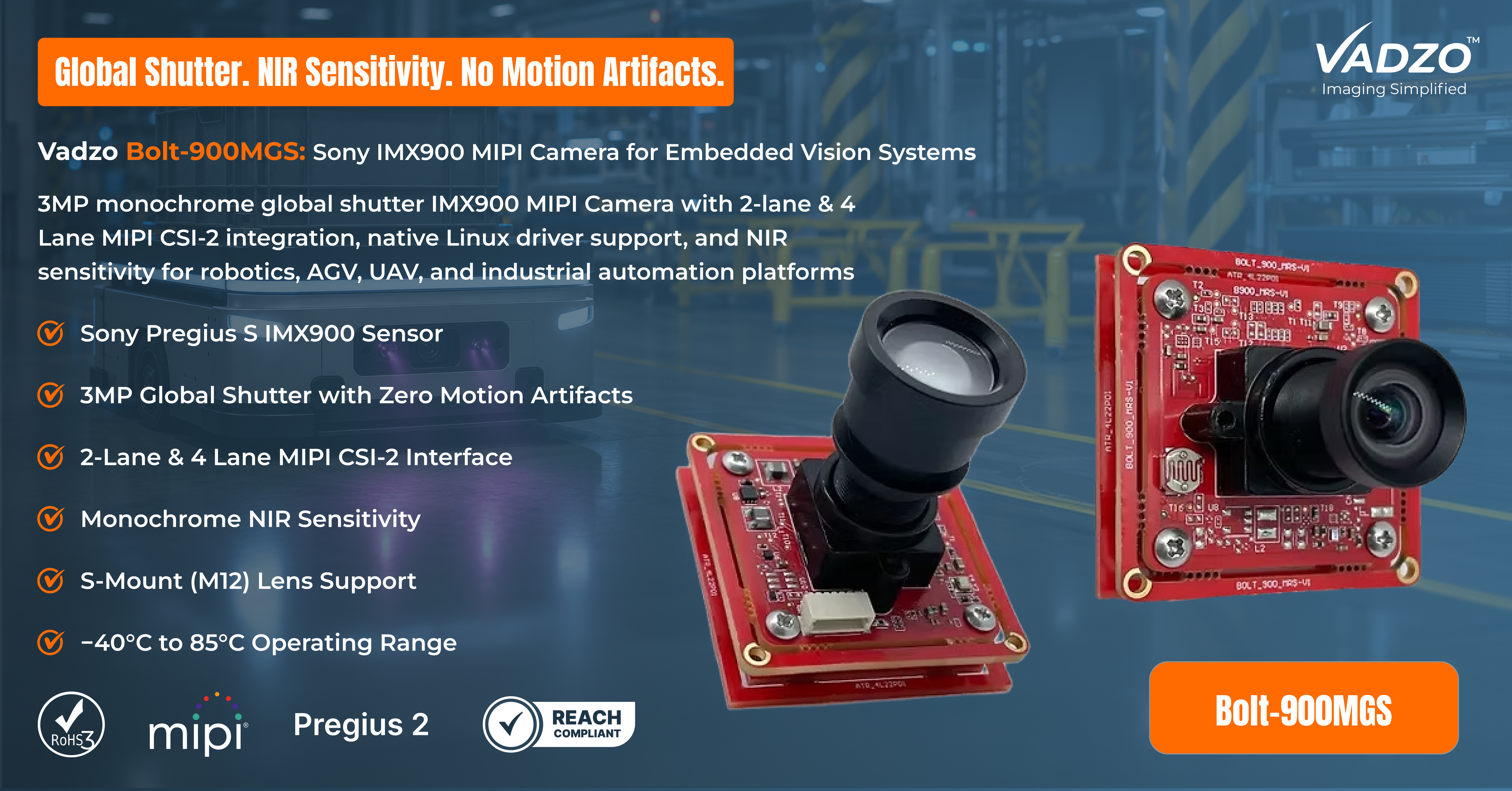
Vadzo's Bolt-900MGS is a 3MP IMX900 MIPI Camera built on the Sony Pregius S IMX900 sensor, delivering monochrome global

Press Release Disclaimer: This is a press release distributed through the XPR Media network. It has not been independently verified by our newsroom.


Vadzo’s Bolt-900MGS is a 3MP IMX900 MIPI Camera built on the Sony Pregius S IMX900 sensor, delivering monochrome global shutter imaging with 2.25 µm pixel pitch, NIR sensitivity, and 2-lane & 4-lane MIPI CSI-2 integration for embedded AI, industrial automation, robotics, AGV, UAV, and medical device platforms where motion-artifact-free capture and low-latency MIPI delivery are simultaneous design requirements. As a compact IMX900 Mono Global Shutter MIPI Camera, it brings high-sensitivity monochrome output and global shutter precision to board-level embedded deployments across Vadzo’s MIPI CSI-2 camera series without USB or network overhead. As an IMX900 Monochrome Camera and IMX900 Mono Camera platform, the Bolt-900MGS also functions as a 3MP Monochrome Camera for OEM programs standardizing on a single monochrome global shutter reference design across product lines.
FORT WORTH, TX / ACCESS Newswire / August 3, 2026 / Vadzo Imaging, a provider of embedded vision camera products, today announces the launch of the Bolt-900MGS, a Sony Pregius S IMX900 MIPI Camera purpose-built for OEM engineering teams who need motion-artifact-free monochrome imaging in a compact board-level MIPI form factor. As a 3MP global shutter MIPI camera delivering 2064×1552 monochrome output with 2.25 μm pixel pitch and 2-lane & 4-lane MIPI CSI-2 integration, the Bolt-900MGS connects directly to embedded AI SoCs in a compact module footprint without USB or network overhead.
Sensor and Camera Overview
The Bolt-900MGS MIPI CSI-2 Camera is built on the Sony Pregius S IMX900, a 1/3.1″ stacked CMOS global shutter sensor with a 2.25 μm x 2.25 μm pixel pitch and a native resolution of 3MP (2064×1552). As an IMX900 Monochrome Global Shutter MIPI Camera, the Bolt-900MGS eliminates the Bayer filter mosaic entirely, maximizing photon capture per pixel and delivering superior sensitivity across both visible and near-infrared spectrums. Built around the Sony IMX900 Image Sensor, the platform is also referred to as an IMX900 Monochrome MIPI Camera or, in shorter form, an IMX900 Mono MIPI Camera across Vadzo’s technical documentation. The Sony Pregius S architecture combines a back-illuminated stacked design with global shutter readout, ensuring every pixel in the frame is captured simultaneously, eliminating the rolling shutter distortion that disqualifies front-illuminated sensors from high-speed inspection, robotics, and motion-sensitive embedded applications.
As a global shutter MIPI camera, the Bolt-900MGS IMX900 MIPI Camera connects via 2-lane / 4-lane MIPI CSI-2 directly to the host SoC ISP, supporting full 3MP output as well as subsampled and windowed Region of Interest (ROI) streaming at higher frame rates. The monochrome MIPI camera architecture removes the color filter layer, giving each pixel full access to the photon flux across the visible and Near Infrared (NIR) spectrum. The camera accepts standard S-Mount (M12) optics, operates across −40°C to 85°C, and is validated for Raspberry Pi 4, Raspberry Pi 5, Jetson Orin Nano, and Jetson Xavier NX platforms. Module-level drivers are provided out of the box. As an Embedded Vision MIPI Camera, the Bolt-900MGS is built for OEM PCB integration rather than standalone enclosure use.
Product Specifications
The table below summarizes the core specifications of this 3MP Global Shutter Image Sensor platform, offered as an IMX900 Global Shutter MIPI Camera for OEM evaluation.
|
Sensor
|
Sony Pregius S IMX900
|
|
Resolution
|
3MP (2064 × 1552)
|
|
Shutter Type
|
Global Shutter
|
|
Sensor Format
|
1/3.1″
|
|
Pixel Size
|
2.25 μm x 2.25 μm
|
|
Interface
|
2 Lane & 4 Lane MIPI CSI-2
|
|
NIR Sensitivity
|
Yes
|
|
Lens Mount
|
S-Mount (M12)
|
|
Operating Temperature
|
−40°C to 85°C
|
|
HDR
|
Quad HDR (up to 120dB)
|
|
Dimensions
|
38 mm (L) × 38 mm (B), convertible to 32mm (L) × 32mm (B)
|
|
Supported Platforms
|
Raspberry Pi, Jetson Orin Nano and Jetson Xavier NX
|
Key Capabilities of the Bolt-900MGS: IMX900 Monochrome Global Shutter MIPI Camera
Global Shutter Precision for Motion-Sensitive Embedded Applications: The most common source of failure in embedded vision systems handling fast-moving objects is rolling shutter distortion, a spatial artifact introduced when a sensor reads out rows sequentially rather than simultaneously. For Automated Guided Vehicle (AGV) navigation systems, robotic vision pipelines, drone-based inspection, and high-speed machine vision on production lines, rolling shutter produces skewed and blurred captures that degrade classification accuracy and invalidate measurement results. The Bolt-900MGS IMX900 MIPI Camera is a high-speed global shutter camera built on the Sony IMX900, capturing all 3MP pixels simultaneously in every frame. This eliminates spatial distortion entirely at the point of capture, delivering geometrically accurate imagery to the inference pipeline without post-processing correction. For OEM teams designing inspection, robotics, or Unmanned Aerial Vehicle (UAV) platforms, the Bolt-900MGS is a 3MP IMX900 MIPI camera that removes motion artifacts as a hardware-level guarantee rather than a software-level approximation. OEM teams sourcing an IMX900 Global Shutter Camera or a 3MP Global Shutter Camera for the same class of application will find the Bolt-900MGS delivers this guarantee without the added cost of a separate rolling shutter to global shutter conversion board.
NIR Sensitivity for Invisible-Illumination Imaging: Many industrial automation camera and security camera deployments require imaging under illumination invisible to the human eye. Standard color sensors with Bayer filter mosaics absorb a significant fraction of NIR-wavelength photons, reducing effective sensitivity at 850 nm and 940 nm and requiring higher-power illumination sources to compensate. The Bolt-900MGS, as a monochrome MIPI camera with no filter layer, routes the full photon flux at every pixel across both visible and NIR spectra directly to the photodiode. The Sony Pregius S IMX900’s back-illuminated stacked architecture compounds this advantage, increasing quantum efficiency in low-illumination conditions and enabling reliable capture under NIR LED arrays without visible lighting. This NIR sensitivity camera is suited for vein recognition, iris biometrics, covert surveillance camera deployments, and material sorting under structured NIR illumination applications where a color sensor of equivalent pixel size delivers insufficient signal-to-noise ratio.
2.25 µm Pixel Pitch for Low-Light Embedded Vision: Pixel pitch is the primary determinant of per-pixel light collection capacity at a given sensor size. At 2.25 μm x 2.25 μm, the IMX900 sensor provides a larger light-gathering area per pixel than many competing 3MP and 5MP sensors at smaller pixel pitches, translating directly into higher signal at lower illumination levels. For embedded MIPI camera deployments in environments where ambient light cannot be controlled, outdoor surveillance camera installations, factory floors with variable lighting, and pathology device imaging under transmitted illumination, this pixel architecture delivers a higher signal-to-noise ratio at the sensor level, reducing reliance on gain amplification and the read noise it introduces. As an industrial MIPI camera, the Bolt-900MGS delivers 3MP monochrome output with per-pixel sensitivity characteristics that support reliable detection in scenes where smaller-pixel sensors require supplemental lighting infrastructure. For OEM teams comparing sensor options, the Bolt-900MGS is also specified as a 3MP Mono MIPI Camera in Vadzo’s product documentation, reflecting the same monochrome pixel architecture described above.
2-Lane & 4-lane MIPI CSI-2 for Low-Latency Embedded AI Integration: The Bolt-900MGS IMX900 MIPI CSI-2 Camera connects via 2-lane / 4-lane MIPI CSI-2 directly to the host SoC ISP, delivering frame data with deterministic, low-latency MIPI camera timing and without the USB enumeration overhead, host driver layer, or network stack that characterize alternative interface architectures. For Raspberry Pi camera, Nvidia Nano camera, and Nvidia Xavier NX camera deployments, MIPI CSI-2 delivery directly into the platform ISP ensures frame timing is consistent and compatible with real-time inference loops. As an embedded MIPI camera operating at 3MP resolution over 2-lane MIPI, the Bolt-900MGS (IMX900 Monochrome Global Shutter MIPI Camera) fits within the bandwidth budget of dual-lane CSI-2 implementations, allowing SoC platforms with limited MIPI lane availability to deploy a full 3MP global shutter sensor without requiring a 4-lane CSI-2 interface. Module-level drivers for Raspberry Pi 4, Raspberry Pi 5, Jetson Orin Nano, and Jetson Xavier NX are provided. Porting support for NXP i.MX, STM, and MediaTek platforms is available on request.
Compact Board-Level Form Factor for OEM Integration: The Bolt-900MGS 3MP IMX900 MIPI Camera is designed as a board-level embedded vision camera, integrating directly into OEM PCB layouts without mechanical redesign. The compact module footprint and S-Mount (M12) lens interface accept both the default lens configuration and alternative focal lengths and field-of-view optics without board changes, giving OEM teams full optical flexibility across kiosk camera, medical device camera, and robotics camera deployments. Operating across −40°C to 85°C, the Bolt-900MGS is suited for deployment in controlled and uncontrolled environments alike, including outdoor surveillance camera infrastructure, AGV camera systems operating on factory floors, and UAV camera payloads with constrained weight and power budgets. This board-level design is also marketed as an IMX900 Monochrome Global Shutter Camera for OEM teams who prefer the shorter product designation in procurement documentation.
“What the Bolt-900MGS delivers to OEM engineering teams is a combination that has historically required trade-offs between sensor size, shutter architecture, and NIR capability. The Sony Pregius S IMX900 resolves that tension directly: 3MP global shutter, 2.25 µm pixels, and full NIR sensitivity in a 2-lane / 4-lane MIPI CSI-2 form factor. For teams building robotics camera, AGV camera, drone camera, or inspection systems on Jetson or Raspberry Pi platforms, this IMX900 MIPI Camera removes the rolling shutter problem at the hardware level and delivers the low-light sensitivity to operate without visible illumination. That is a meaningful reduction in system design complexity for any embedded vision application where motion and lighting are both variables” – Alwin Vincent, Product Manager, Vadzo Imaging.
Target Applications
Industrial Inspection and Machine Vision: The global shutter readout of this 3MP mono global shutter MIPI camera eliminates motion artifacts on high-speed production lines, making the Bolt-900MGS directly applicable to surface defect detection, dimensional measurement, and barcode reading applications where conveyor speed and camera frame timing interact. The NIR sensitivity enables imaging under structured infrared illumination without disrupting visible-light production environments, and the 2.25 µm pixel pitch delivers sufficient per-pixel sensitivity to support consistent detection in variable factory floor lighting.
Robotics, AGV, and UAV Systems: Low-latency 2-lane / 4-lane MIPI CSI-2 integration with Jetson and Raspberry Pi platforms supports real-time object detection, obstacle avoidance, and navigation for robotic camera and AGV camera deployments. The global shutter architecture ensures geometrically accurate frame capture during platform motion, which is a prerequisite for reliable localization and path-planning algorithms. As a UAV camera, the compact form factor and low-power Sony Pregius S IMX900 sensor keep payload weight and power within the tight budgets that aerial platforms impose on imaging subsystems. As an embedded robotics vision camera, the Bolt-900MGS supports both AGV vision camera and AMR navigation camera architectures, where global shutter capture eliminates the frame-to-frame drift that rolling shutter sensors introduce during continuous platform motion. In vision guided robotics camera deployments, including collaborative robot camera installations on shared factory floors and pick and place vision camera systems on assembly lines, the same global shutter robotics camera architecture that removes motion artifacts for navigation also holds part edges and fiducial markers geometrically stable for object recognition and grasp planning. As a robotics vision MIPI camera built for high-speed machine vision camera applications, the Bolt-900MGS also functions as a motion tracking camera for multi-axis robotic arms where the global shutter guarantees frame-accurate position feedback.
Medical Device and Pathology Imaging: Monochrome global shutter capture delivers spatially accurate, high-contrast output suited for pathology devices, diagnostic instrumentation, and surgical guidance systems where color information is secondary to spatial resolution and tonal accuracy. The Bolt-900MGS, as a medical device camera, operates within the compact board-level form factor required for portable diagnostic platforms, and the NIR sensitivity extends its utility to fluorescence and multispectral clinical imaging modalities.
Security, Surveillance, and Kiosk Systems: NIR sensitivity and global shutter capture make the Bolt-900MGS effective in security camera and surveillance camera installations where subjects move across the field of view, and ambient lighting varies between daytime and nighttime conditions. As a kiosk camera for access control, self-checkout, and identity verification deployments, the 3MP resolution and global shutter eliminate blur on faces and hands in motion, improving biometric capture accuracy at the point of sensor output.
Drones and Aerial Inspection: As a drone camera and UAV camera, the Bolt-900MGS IMX900 MIPI Camera combines global shutter precision with NIR capability to support aerial mapping, infrastructure inspection, and precision agriculture applications where platform vibration and rotor wash introduce apparent motion that rolling shutter sensors cannot handle cleanly. The compact S-Mount lens interface supports wide-angle optics for mapping and narrower focal lengths for close-range inspection without platform redesign.
Frequently Asked Questions
Q: Why should OEM teams choose an IMX900 MIPI Camera for motion-sensitive embedded vision applications?
A: The Bolt-900MGS is Vadzo’s dedicated 3MP global shutter MIPI camera built on the Sony Pregius S IMX900 sensor, specifically engineered for applications where motion-artifact-free monochrome capture, NIR sensitivity, and compact 2-lane / 4-lane MIPI CSI-2 integration are simultaneous requirements, making it the right choice for robotics, AGV, high-speed inspection, and edge AI deployments. Motion-sensitive embedded vision applications are defined less by absolute frame rate and more by the ratio between subject velocity and the per-frame exposure and readout window. An AGV traveling at typical warehouse speeds, a conveyor-mounted inspection station running at production line takt time, or a drone experiencing rotor-induced vibration all introduce relative motion between the sensor and the scene during capture. The IMX900 MIPI Camera resolves motion artifact risk, low-light sensitivity, and MIPI bandwidth constraints in a single board-level module rather than requiring OEM teams to combine separate hardware for each requirement. Full technical documentation and evaluation ordering information for the IMX900 Monochrome Global Shutter MIPI Camera is available directly from Vadzo.
Q: What is the advantage of Sony Pregius S global shutter over rolling shutter sensors at 3MP resolution?
A: Rolling shutter sensors read out pixel rows sequentially, introducing spatial distortion on objects in motion relative to the sensor. At 3MP resolution on a robotics camera or AGV camera moving at operational speed, this produces measurable skew and blur that degrade detection accuracy and invalidate dimensional measurements. The Sony Pregius S IMX900 captures all pixels simultaneously, delivering geometrically correct frames regardless of subject or platform motion. This is not a post-processing correction. It is a sensor architecture guarantee. A rolling shutter sensor exposes and reads out each row in sequence, so the top and bottom of a frame are captured at slightly different points in time, and at typical AGV, conveyor, or drone velocities that time difference is large enough to shift a feature’s apparent position by multiple pixels between the top and bottom of the same frame. The Sony Pregius S IMX900 avoids this at the hardware level by moving every pixel’s collected charge into a shielded storage node simultaneously before readout begins, so the entire frame represents a single instant regardless of how long the readout itself takes. This architectural difference is the primary reason a global shutter camera is specified for motion-critical stages rather than a rolling shutter alternative at comparable resolution and cost. OEM teams referring to this sensor generation as a Sony IMX900 Global Shutter Camera or a Sony Pregius IMX900 Camera in their own technical specifications are describing the same Sony Pregius S IMX900 architecture.
Q: Which SoC platforms does an IMX900 MIPI Camera support?
A: Module-level drivers are provided for Raspberry Pi 4, Raspberry Pi 5, Jetson Orin Nano, and Jetson Xavier NX, covering the primary embedded Linux platforms used in production robotics, edge AI, and industrial deployments. Driver porting support for NXP i.MX, STM, and MediaTek platforms is available on request from Vadzo’s engineering team. Each platform is delivered through standard V4L2 Linux kernel drivers and device tree overlays rather than a proprietary SDK layer, so OEM engineering teams can integrate the camera using the same media controller pipeline, GStreamer, and OpenCV workflows already used across other embedded Linux camera integrations. Raspberry Pi 5 deployments typically suit cost-sensitive volume production where the camera runs alongside standard Linux tooling. Jetson Orin NX and Jetson Orin Nano deployments are more common where the platform is also running an onboard inference model and needs the IMX900’s global shutter output delivered with minimal added latency ahead of a neural network pipeline.
Q: Why does monochrome sensor architecture improve NIR imaging compared to a color IMX900 MIPI Camera variant?
A: Color sensors use a Bayer filter mosaic that absorbs a substantial fraction of incident light, including most NIR-wavelength photons, to separate color channels. The Bolt-900MGS, as a monochrome MIPI camera with no filter layer, routes the full photon flux at every pixel directly to the photodiode across both visible and NIR spectra. At 850 nm and 940 nm NIR illumination wavelengths used in biometric and covert surveillance applications, this delivers significantly higher signal-to-noise ratio than a color sensor of equivalent pixel pitch. At 850 nm and especially at 940 nm, a significant share of the photons reaching a color sensor’s surface are absorbed by the dye layer before reaching the photodiode, so the sensor’s effective quantum efficiency at those wavelengths is a fraction of what the silicon is physically capable of capturing. Removing the filter layer lets every photon that reaches the pixel contribute to the signal regardless of wavelength, which is why monochrome sensors remain the standard choice for vein pattern recognition, iris biometric capture, and covert surveillance deployments where illuminating a scene with visible light is not an option. It also means an NIR-sensitive camera in this class can operate at lower NIR LED drive currents for the same signal level, reducing illumination board power budget and thermal load in compact enclosures.
Q: Can an IMX900 MIPI Camera be customized for OEM integration in volume production?
A: Yes. Vadzo supports full OEM customization across the Bolt-900MGS, including form factor modification, board redesign, firmware development, NIR and visible LED illumination board integration, lens holder and optical filter modifications, and IP-rated enclosure design. Evaluation units are available with no minimum order requirement, and volume production customization is available through Vadzo’s OEM camera engineering team. Customization typically begins with an evaluation unit built to the standard 38 mm by 38 mm form factor, which OEM teams use to validate imaging performance, driver integration, and mechanical fit before committing to a board redesign. From there, Vadzo supports conversion to the compact 32mm by 32mm footprint for space-constrained platforms, custom connector and cable routing to match an existing PCB layout, and firmware modifications for application-specific exposure, gain, and streaming behavior. For robotics and AGV programs that need additional sensing beyond image capture, Vadzo also supports integrating Time of Flight, mmWave Radar, and IMU sensors onto the same board, so a single module can deliver combined depth, motion, and monochrome image data over one interface rather than routing separate sensors to the host SoC. Because evaluation units carry no minimum order requirement, engineering teams can validate the base IMX900 Monochrome Global Shutter MIPI Camera platform before scoping NRE and volume terms with Vadzo’s OEM camera engineering team.
Availability and Customization
The Bolt-900MGS Sony Pregius S IMX900 MIPI Camera is available now for evaluation and OEM integration. To request full specifications or an evaluation unit, contact the Vadzo Imaging sales team at support@vadzoimaging.com. OEM teams may also see this platform listed as a 3MP Monochrome Global Shutter Camera in distributor and marketplace catalogs, referring to the same Sony Pregius S IMX900 module described throughout this release.
Vadzo supports full OEM customization across the Bolt-900MGS IMX900 MIPI Camera, including form factor modification and board redesigns, firmware development and custom feature integration, NIR and color LED array board design and integration, advanced sensor integration for ToF (Time of Flight), mmWave Radar, and IMU, lens holder modifications and electro-mechanical lens filter control, and full enclosure design in both IP-rated and non-IP-rated configurations. As part of Vadzo’s MIPI CSI-2 camera series, the Bolt-900MGS carries the same OEM support infrastructure available across Vadzo’s full embedded vision camera portfolio. Driver porting support for NXP i.MX, STM, and MediaTek platforms is available on request. Vadzo also lists this module as a 3MP Monochrome Global Shutter MIPI Camera in its ordering documentation, reflecting the same evaluation and production pathway described above.
About Vadzo Imaging
Vadzo Imaging develops embedded and machine vision camera products for OEMs and system integrators building production-ready vision systems across industrial automation, robotics, healthcare, and smart infrastructure. The company’s camera portfolio spans MIPI CSI-2 Camera, USB Camera, GigE Camera, Wi-Fi Camera, and SerDes Camera interfaces, supporting a wide range of embedded deployment architectures. Vadzo provides end-to-end imaging support including sensor integration, ISP tuning, firmware development, and SDK frameworks to accelerate system deployment. Learn more at www.vadzoimaging.com.
Media Contact
Alwin Vincent
Vadzo Imaging
Email: alwin@vadzoimaging.com
LinkedIn: Vadzo Imaging
YouTube: Vadzo Imaging
X: Vadzo Imaging
SOURCE: Vadzo Imaging
View the original press release on ACCESS Newswire
Media gallery